
Article · 11 minute read
Cork Flooring for Aged Care Facilities in Australia
Cork and rubber composite flooring is a strong fit for Australian aged care, and in several areas it outperforms vinyl, carpet, and timber on the things that actually matter to residents and operators. Here is how it stacks up against the requirements that aged care projects are written against, and where the trade-offs sit.
What aged care flooring actually needs to do
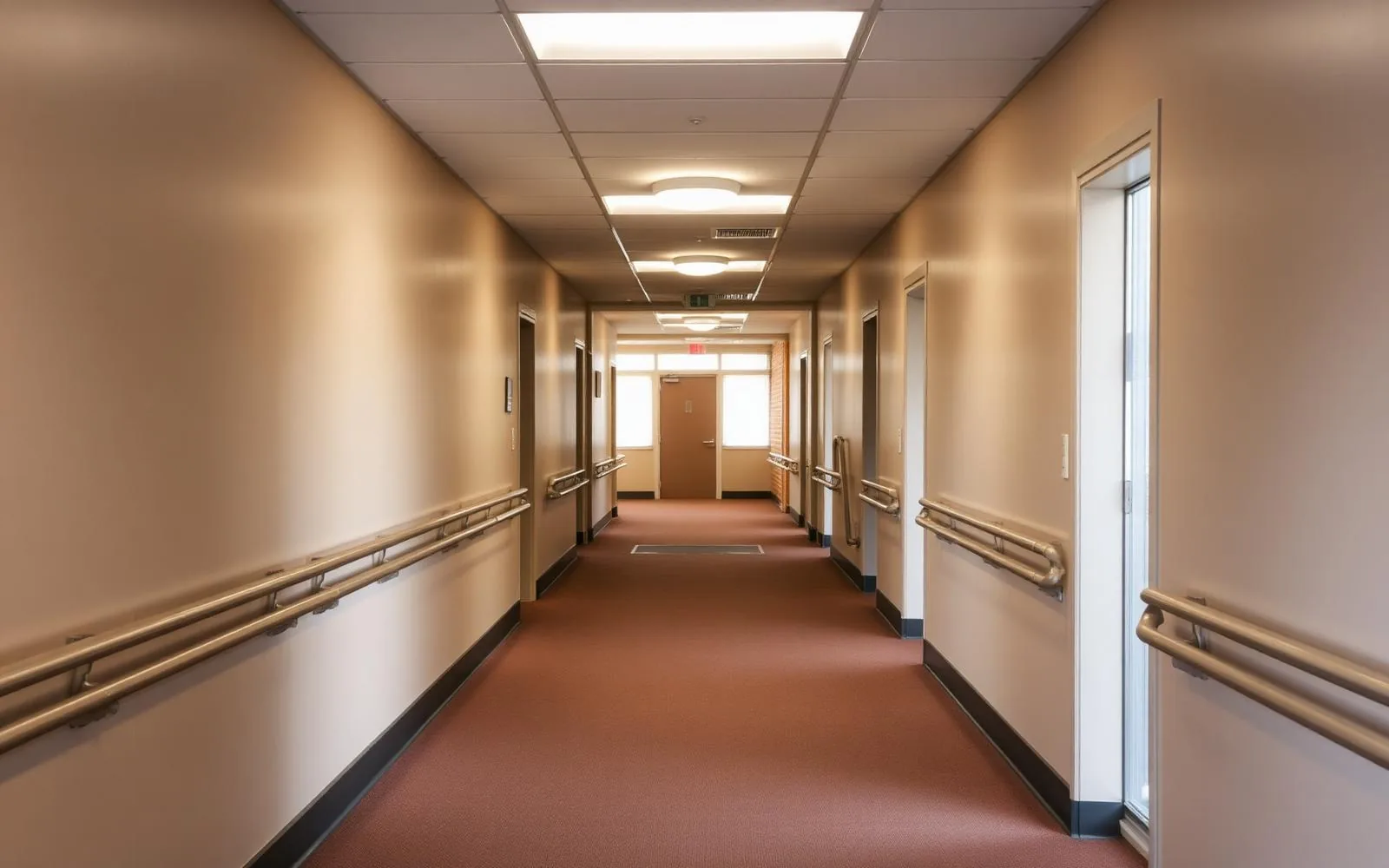
A nursing home floor sees more wear in a year than most retail floors see in three. Wheelchairs and walkers run across it continuously. Mobile lifters and meal trolleys cover the same corridors every morning and every evening. Residents shuffle, sometimes barefoot. Cleaning crews work overnight, often with caustic chemicals and high-flow equipment.
On top of the wear, the regulatory picture is dense. The Aged Care Quality Standards (Standards 5 and 7 in particular) push operators to provide a safe, comfortable, dignified environment. The National Construction Code adds requirements around fire performance, slip resistance, and accessibility. State infection prevention guidelines pile on cleaning expectations. Then there is procurement: most providers run formal Green Star or NABERS targets, and federal aged care building grants increasingly reward low-VOC and low-embodied-carbon materials.
A single floor that ticks every box is rare. Vinyl ticks cleanability. Carpet ticks acoustic and comfort. Rubber ticks slip and impact. Cork on its own ticks sustainability. The reason cork-rubber composites have been turning up in aged care specifications over the last few years is that they cover most boxes at once, without the trade-offs you get from picking one material.
Slip resistance, the non-negotiable
Falls are the single most common adverse event in residential aged care in Australia. AIHW data has falls accounting for roughly half of all reported injury hospitalisations for people aged 65 and over, and in residential care the fall rate sits around six falls per 1,000 occupied bed days. Every facility has fall prevention as a clinical priority, and flooring is one of the few interventions that helps every resident at once, every minute of every day.
The slip resistance metric to look for in Australia is the wet pendulum classification under AS 4586, expressed as P0 to P5. The wet ramp classification (R9 to R13) is also used, although pendulum is the more common reference for aged care interiors. General aged care corridors usually need a minimum of P3. Bathrooms, ensuites, and laundries push that to P4 or P5. Outdoor terraces and pool decks, common in higher-end facilities, need P5.
Comcork is independently tested to AS 4586. The standard WalkEasy profile achieves P3 in dry interior conditions. The Textured profile reaches P5 wet, which covers ensuites, communal showers, kitchen service zones, and the awkward transition spaces where wet floors meet dry. Critically, the slip rating does not depend on a topical sealant that wears down over time. It is built into the surface profile.
This matters because vinyl safety flooring achieves its R10 or R11 rating through embedded carborundum particles in a topcoat. As the topcoat wears, the rating drops. In a high-traffic aged care corridor, that can happen within five to seven years. Comcork's slip performance is structural, not surface-applied, and lasts the life of the floor.
Sound, sleep, and the dementia care wing
Noise in aged care is not just an amenity issue. For residents with dementia, ambient noise drives agitation, sundowning, and sleep disturbance. Research from UNSW and the Dementia Centre has repeatedly linked excessive noise in residential care with increased medication use and falls.
Hard floors amplify everything. A walker dragged across vinyl is loud. A meal trolley rolling on tile is louder. Doors closing, voices raised, alarms going off, and the cumulative sound of a facility at shift change can push interior noise above 70 dB in poorly designed buildings.
Cork-rubber composites are the most acoustically forgiving of the resilient floor categories. Comcork has an independently measured impact sound reduction (ΔLw) of 19 dB across the standard product range. That is materially better than homogeneous vinyl, which sits in the 4 to 8 dB range without an underlay, and competitive with rubber-only floors. For multi-storey facilities where bedrooms sit above corridors or service zones, the difference between vinyl and Comcork can be the difference between residents sleeping through morning trolley runs or being woken by them.
Airborne sound is also reduced, although the effect is less dramatic. Where the real benefit shows up is in the subjective acoustic feel of a space. Comcork dampens the harshness of footsteps and trolley wheels in a way that residents and staff describe as calmer, even if they cannot point to a specific decibel reduction.
Falls happen. Soften the landing.
You can specify the highest slip rating in the country and falls will still happen. Cognitive decline, medication side effects, postural hypotension, and frailty all bypass any flooring intervention. The question is what happens when a resident does go down.
This is where cork and rubber genuinely separate from vinyl and tile. The cellular structure of cork compresses on impact, then recovers. Rubber adds elasticity. Together they reduce peak deceleration on a fall, the metric most closely correlated with hip fracture risk.
There is a class of floors marketed specifically as fall-injury-reduction surfaces, with thicker rubber underlays designed to soften impact. They work, but they trade off stability under wheelchairs and walkers, and many residents report a spongy feel they do not like. Comcork at 2.5, 3.5, or 4.5 mm sits in a different place: a dense cork-rubber composite that takes the edge off a fall while staying firm enough that a wheelchair tracks straight and a walker does not bog down.
This is also where standing comfort comes in for staff. Personal care workers and nurses spend long shifts on their feet. Cork's natural give reduces lower-back, knee, and ankle fatigue. WorkSafe claims data in healthcare settings consistently shows musculoskeletal injuries as the largest category, and underfoot comfort is one of the cheapest interventions available.
Cleanability and infection control
Aged care infection prevention guidelines borrow heavily from acute hospital protocols. Floors need to be cleanable with hospital-grade disinfectants, withstand regular wet mopping, resist microbial growth at seams and joints, and not harbour spilled bodily fluids. This is where carpet falls out of the conversation in clinical zones, and where some natural materials hit limits.
Once installed, Comcork is sealed on site with a polyurethane finish that protects the surface against liquid penetration. The finish is rated for use with the disinfectants typically specified in aged care: quaternary ammonium compounds, hydrogen peroxide based cleaners, and 70 percent isopropanol. Bleach-based disinfectants are also tolerated, although not recommended for daily use.
Sheet Comcork is preferred over tile in clinical zones because cold-welded sheet seams (a chemical seam sealer applied into a routed channel - thermoplastic heat welding is not used on Comcork) produce an effectively monolithic surface. There are no joints for biofilm or spilled fluids to track into. Tile works fine in residential-style rooms and lounges where seam exposure to liquids is low.
One practical advantage worth flagging: Comcork is straightforward to maintain. Day-to-day cleaning uses standard commercial products, and we recommend periodically resealing the floor as a simple routine that brings it back to as-new condition. There is no need for the disruptive 12 to 18 month strip-and-reseal program vinyl is often on, which means closed wings, displaced residents, and disrupted routines. The lifecycle numbers tend to look favourable once operators factor that in.
Indoor air quality and resident health
Older residents, particularly those with COPD, asthma, and immune compromise, are disproportionately affected by indoor air quality. Flooring is one of the larger contributors. Vinyl, particularly cheaper imports, can off-gas plasticisers and residual solvents for years after installation. Carpet harbours dust mites, mould spores, and allergens that vacuuming cannot fully remove.
Comcork is manufactured without phthalate plasticisers and without added chemical binders. It is GreenTag Level C certified, which independently verifies low VOC emissions across the product life cycle. The cellular structure of cork is naturally inhospitable to dust mites, and the sealed surface leaves nowhere for allergens to settle.
For facilities pursuing a Green Star Healthcare rating, Comcork contributes to the Indoor Environment Quality and Materials credits without needing additional documentation rounds. The technical data, including Environmental Product Declarations, is on file and ready for specifiers to attach to submissions.
Sustainability and aged care procurement
Procurement teams in aged care increasingly run on dual mandates: clinical performance and ESG performance. Federal aged care funding agreements now include sustainability clauses, and most state-level capital programs reward low-embodied-carbon materials in the design rationale.
Cork is one of the few building materials with a verified negative carbon footprint over its full life cycle. Comcork measures at minus 1.3 kg CO2-e per kilogram of product, which means every square metre installed sequesters more carbon than its manufacture and transport release.
Cork bark is harvested from cork oak trees without felling. Each tree regenerates its bark over a nine year cycle and lives 200 years or more, sequestering more carbon during that time than a non-harvested oak. The oak forests of Portugal, where the cork in Comcork originates, are among the most biodiverse temperate ecosystems in Europe and exist commercially because of cork demand.
For operators reporting under TCFD, the National Greenhouse and Energy Reporting Scheme, or voluntary Climate Active commitments, having a flooring material that scores negative on its EPD makes the spreadsheet easier.
Durability under the realities of aged care
Aged care floors face wear conditions most commercial floors will never see. Castors, hard rubber wheels, walking-frame rubber tips, dropped meal trays, mobility scooters, electric beds being repositioned, and the cumulative weight of two-person assist transfers all leave their mark.
Comcork carries a 10 year commercial warranty in standard aged care use. The product is tested for indentation resistance under prolonged static loads (relevant for bed castors and wheelchair stands), rolling load (relevant for medical equipment movement), and abrasion. The typical wear pattern reported in commercial use is gradual surface dulling rather than scratching, gouging, or seam failure.
If a section is damaged, most often from a dropped sharp object, Comcork can be patch repaired without replacing the whole sheet or tile. Replacement material is colour-matched from the same production batch where possible, and the manufacturer holds reserve stock against ongoing project specifications.
Where Comcork fits inside an aged care building
A single product is rarely correct for every space in a facility. Here is how Comcork is typically zoned through a build or refurbishment, profile by profile.
- Resident bedrooms
- WalkEasy or Low Profile in warm tones. Comfortable underfoot, quiet, visually soft. Allergen and dust friendly.
- Corridors and dayrooms
- Low Profile in mid tones. High traffic, high cleanability, acoustic dampening built in.
- Ensuites and communal showers
- Textured for P5 wet slip resistance. Can be coved up the wall for full waterproof detail.
- Dining rooms
- Low Profile in design-led tones. Easy to clean, comfortable for long meal services, acoustic.
- Memory care wings
- WalkEasy in calm, low-contrast tones. Acoustic dampening is the clinical priority. Avoid high-contrast pattern changes that residents with dementia can read as steps.
- Hairdressing salons and therapy rooms
- WalkEasy with a feature colour. Comfortable for staff and residents on extended stays.
- Outdoor terraces and shaded courtyards
- AquaDeck. Built for UV, water, and outdoor temperature swings.
- Service corridors and back of house
- Textured or Low Profile. Built to take it.
Getting Comcork supplied and installed
Aged care operators and facility managers can request samples, a site visit, and a supply-and-install quote via the enquiry form on comcorkflooring.com.au. For a broader view of flooring options across aged care environments - including comparisons with vinyl, carpet, and rubber - see agedcareflooring.com.au.
Premrest is a specialist flooring contractor that supplies and installs Comcork as part of a complete site service. Aged care fitouts and refurbishments need a contractor that understands working in occupied buildings, tight infection control protocols, after-hours staging, and dust suppression - Premrest scopes installs against those constraints, including staged room-by-room works and after-hours programming where required.
For a quote on supply and installation, contact Premrest via the enquiry form on comcorkflooring.com.au.
Frequently asked
Frequently asked questions
Does cork flooring meet NCC fire requirements for aged care buildings?
Yes. Comcork is tested to AS ISO 9239.1 and meets the critical radiant flux requirements for Class 9c aged care buildings, including egress corridors and exits. Fire performance documentation is available on request.
Can cork flooring be installed over the existing concrete slab?
Most aged care facilities have ground-bearing slabs that are suitable substrates after preparation. Premrest assesses moisture content, levelness, and contamination before installation. Where moisture content exceeds the manufacturer threshold, an epoxy moisture barrier is applied first.
Is cork flooring suitable for memory care wings?
Yes, with care taken on colour selection. Residents with dementia can perceive sharp colour transitions as level changes, which can trigger anxiety or fall risk. Specify low-contrast, tonally similar colours within memory care zones, and reserve high-contrast detailing for handrails and door frames where wayfinding helps.
How does cork flooring compare to vinyl in aged care?
Cork-rubber outperforms vinyl on acoustic dampening, fall impact reduction, indoor air quality, and embodied carbon. Vinyl can match cork on cleanability and initial cost. Over a 15 to 20 year lifecycle, cork-rubber is generally cost competitive once strip-and-reseal cycles, replacement timelines, and acoustic underlays are factored in.
Is cork flooring waterproof in aged care bathrooms?
The Textured Comcork profile, supplied as sheet with cold-welded chemical seams and coved skirtings, is suitable for wet areas when correctly installed. The cold weld fuses adjoining sheets into a continuous surface. The manufacturer recommends Comcork is left unsealed in wet areas and where maximum slip resistance is required, because topical sealing reduces wet anti-slip performance - Premrest follows that guidance for ensuites, communal showers, and similar wet spaces.
What is the typical lead time for an aged care project?
Standard Comcork colours are held in Australian stock and ship within two weeks. Custom or feature colours run on production schedules of 8 to 12 weeks. Premrest will scope and confirm lead times against the construction program at the quoting stage.
What warranty applies in aged care use?
Comcork carries a 10 year commercial warranty for general aged care use. The warranty covers wear, surface integrity, and product defects. Premrest provides a separate workmanship warranty on the installation.
Want Comcork on your floor? We’ll supply and install it.
Comcork is supplied and installed by Premrest, a commercial flooring contractor working across Melbourne, Sydney, Brisbane and the rest of Australia. We also supply and install commercial vinyl, rubber, carpet tile, polished concrete and resin systems.
More reading
Other Comcork articles
How to Clean Comcork Flooring
How to clean and maintain Comcork cork-rubber flooring - pH-neutral mopping, CRB and orbital deep-clean methods, and when to strip and reseal.
Cork Flooring in Bathrooms
Yes - cork & rubber flooring works in bathrooms when specified correctly. Slip ratings, waterproofing details, and the right Comcork profile to choose.
Cork Flooring Over Tiles
Installing cork flooring over existing tile: when it works, when it doesn't, and the substrate prep that determines whether the install lasts 10 years or 2.
Are Cork Floors Durable?
Cork flooring is more durable than people expect. Indentation, abrasion, rolling load, and the test data behind Comcork's 10-year commercial warranty.
Cork vs Vinyl vs Rubber
How cork-rubber composite flooring compares to commercial vinyl and pure rubber across slip resistance, acoustics, comfort, sustainability, and lifecycle cost.
Cork Flooring Cost per m² Australia 2026
Cork flooring cost per m² in Australia: Comcork cork-rubber (cork and rubber mix) supply and installation pricing for Melbourne, Sydney, and Brisbane projects.
Cork Flooring Melbourne, Sydney, Brisbane
Australian-made cork & rubber flooring supplied and installed by Premrest across Melbourne, Sydney, and Brisbane. Commercial fitouts, refurbs, and residential.
Cork Flooring for Strata
Why cork-rubber flooring like Comcork suits strata apartments: impact-isolation, BCA acoustic compliance, comfort, and what owners' corporations need to know.
Cork Flooring for End of Trip
Why cork-rubber flooring suits end of trip facilities: acoustic performance, durability under bike traffic, slip resistance in wet areas, and Australian manufacturing.
Let’s talk floors.
Tell us about your site and we’ll take it from there: a site visit, samples and a fixed price to supply and install Comcork.